.png?width=1200&height=245&name=PaySauce-horizontal(red).png)



30 April 2026
Are Small Businesses Actually Ready for Payday Super?
PayDay Super
Company
Are small businesses actually ready for Payday Super?
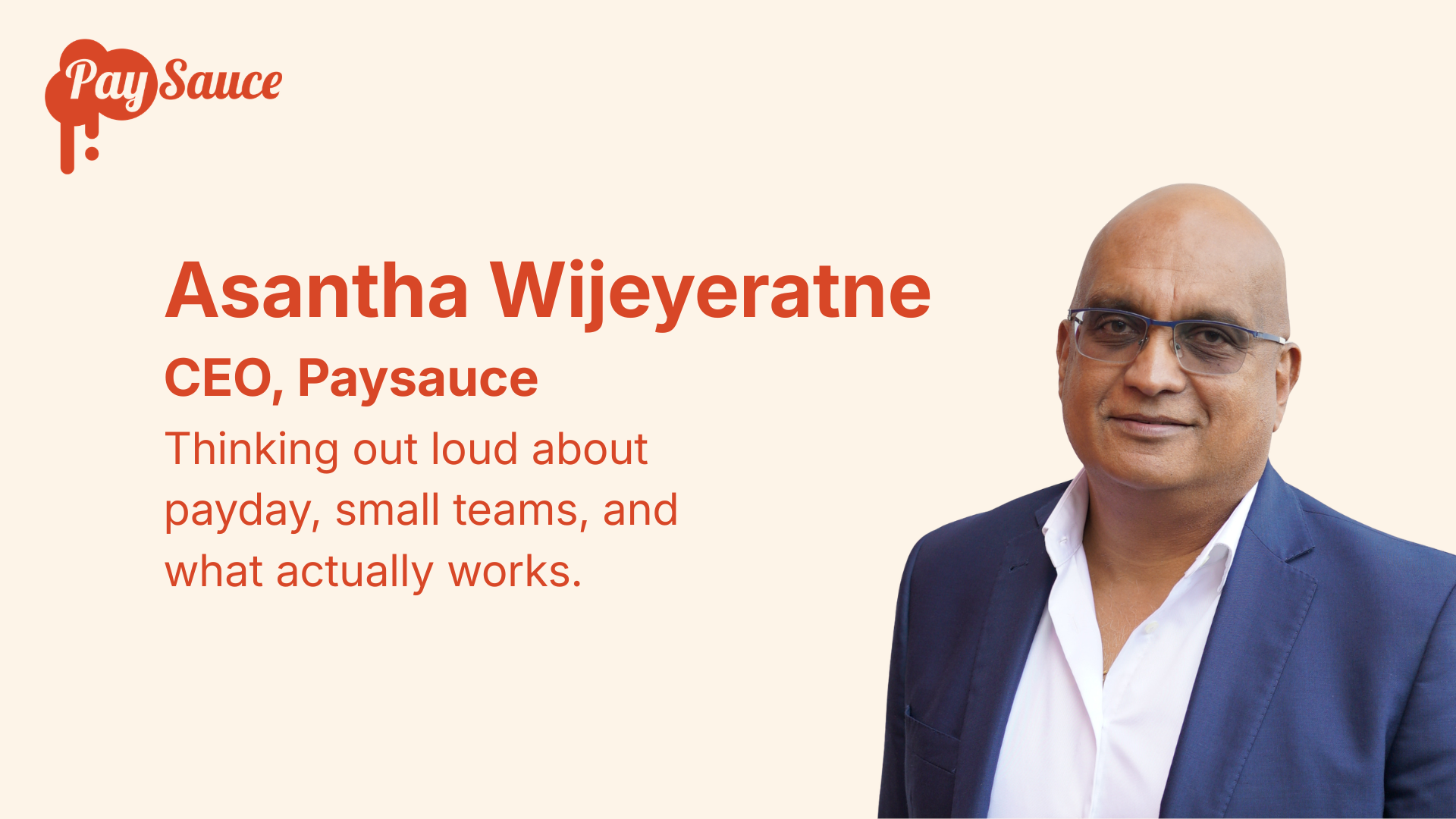
Author Asantha Wijeyeratne, CEO, PaySauce
ACCI called this week for a delay to the introduction of Payday Super. I understand the instinct. Small businesses are already stretched, and adding a new layer of obligation on top of everything else they are managing is a real concern. But I think the delay debate, while legitimate, is distracting us from a more important conversation.
Most small business owners I speak to are not arguing about the policy timeline. They are confused about what this actually means for the way they run their business week to week. And that gap, between what is being debated and what is actually being felt, is where the real risk sits.
The change is more fundamental than people are framing it.
Super is moving from something you think about once a quarter to something that happens every single payday. That sounds simple. But for a business owner managing cash flow, staff, customers and everything else at the same time, the rhythm of when money leaves the business matters enormously.
This is not just a reporting change or an administration update. It is a shift in the financial heartbeat of running a small business. Obligations that used to be predictable and quarterly become frequent and immediate. For a cafe owner with four staff, a landscaper running a crew of three, or a retailer who does payday themselves on a Sunday night, that is a meaningful change to manage.
What I am actually hearing is not resistance. It is confusion.
The business owners I talk to are not opposed to the idea of super being paid more frequently. Many of them think it is fair. It is the employees' retirement savings that should be working hard for them as soon as possible. What they are struggling with is the practical question of what they need to do differently, and whether what they are currently doing will hold up.
For a business owner who is master of their craft, compliance obligations are generally outside their comfort zone. Questions like: what changes in my process? How does this affect my cash flow timing? What happens if I get it wrong? These are the questions coming up, and they are not finding clear answers in the current debate.
There is plenty of noise about the policy. There is not much clarity for the person doing payday on their own at 9pm on a Thursday. This is the invisible backbone of our country's economy under additional stress.
That is where the real risk sits.
Not in the legislation. In the gap between what changes and what small businesses actually understand about what to do next.
These are business owners who do not have a back office team of payroll, HR and finance people. All those roles are just the one person who also has to run the business. When people adapt on the fly without clear guidance, that is when mistakes happen. That is when they end up spending extra hours second-guessing their payday process, calling their accountant more than they should need to, or simply getting it wrong and dealing with the consequences later.
That mental load is easy to underestimate if you are not the one carrying it. But for a business owner who is already managing everything from compliance to customer experience to staffing, adding uncertainty to one of their biggest regular financial obligations is a genuine burden. This is even more relevant in today's challenging and uncertain business environment.
Whether it is delayed or not, this change is coming.
The timing might shift. But the direction is clear. Super is moving closer to payday. That is the right direction, in my view. Workers should not have to wait a quarter for super that was earned every fortnight to start working for their retirement. But getting the direction right does not mean execution takes care of itself.
The question we should be focused on is how we make this manageable for small businesses. Not by adding complexity or requiring them to become payday experts, but by making sure the tools, the guidance, and the support structures are in place before the obligation hits.
This is exactly why we built PaySauce
We built PaySauce specifically for this kind of business owner. The one with one to ten employees. The one doing payday themselves. The one who does not have a payroll team, an HR department, or time to study superannuation legislation.
I relocated to Melbourne to lead our Australian launch personally because I believe this market needs what we have built, and because this moment, right now, is exactly when it matters most.
Our whole approach has been to make payday something that just works. Paid correctly. On time. Every time. That is not a marketing line. It is the problem we have been solving for ten years in New Zealand, and it is the problem we are here to solve in Australia.
Payday Super does not need to be complicated if you have the right setup. But if you are still running payday through a spreadsheet or a tool that was not built for this, the window to sort that out is getting shorter.
What this moment is really telling us
The debate around Payday Super, whether it should be delayed, accelerated, or adjusted, is a policy conversation worth having. But underneath it is a simpler truth. Payday is already too complex for too many small businesses. This change is exposing that. And simplicity, real simplicity, matters more than ever right now.
Payday sorted.
Asantha Wijeyeratne is the CEO of PaySauce. He relocated from New Zealand to Melbourne in 2025 to lead PaySauce's Australian expansion. PaySauce is a mobile-first payday solution built for small businesses.